
Tom Anв Jerry story
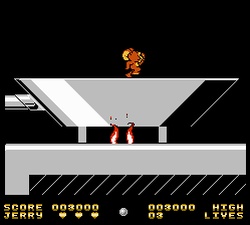
The story of Tom & Jerry on NES isn’t about dates and stats, it’s about a feeling: a yellow cart in your hands, a leaping cat on the label, and a cheeky mouse clutching a wedge of cheese. Some kids just called it “Tom and Jerry on the Dendy,” others “the cat-and-mouse game,” while the title screen flashed the proud Tom & Jerry: The Ultimate Game of Cat and Mouse. Back then “ultimate” read as “the real deal”: the chase the way it should be—endless, funny, and just a tiny bit dangerous.
From cartoon to cartridge
The late ’80s and early ’90s kicked off a boom in licensed games, and the owners of classic cartoons gladly let their stars hop from TV into 8‑bit worlds. Under publisher Hi Tech Expressions, the team carefully lacquered familiar gags into platformer form: vases shatter into shards, toast rockets from the toaster, soap bubbles skitter underfoot, and somewhere just off-screen prowls Tom the cat. Box blurbs promised the “ultimate cat and mouse,” and on Japanese Famicom boxes from Altron you’d spot a Turner Entertainment notice—yep, all above board, official Tom to Jerry, not some back-alley knockoff.
The leap from cartoon to game was surprisingly respectful. The devs didn’t force the brand into a mismatched genre; they translated what everyone loved into pixels: the snappy chase, the mean-but-harmless pranks, pure slapstick without bruises. The plot is a quick sketch—Jerry rescues his baby buddy (some grew up saying “Nibbles,” others “Tuffy”) and makes a run for it from a forever-hungry Tom. Nothing extra, and the vibe lands in seconds.
Getting into players’ hands
Tom & Jerry hit in 1991 and spread fast across regions: Hi Tech Expressions pushed it in the States, while Altron handled the Famicom release in Japan. But it found a second home in our neck of the woods, where “Dendy” became shorthand for childhood. On the market you’d see 9,999‑in‑1 multicarts with wonky cropped art, or single carts labeled “Tom & Jerry” or simply “Cat and Mouse.” Menus might say “Tom&Jerry Ultimate” one day and “Cat-and-Mouse Game” the next. Didn’t matter—everyone knew it was that house-wide chase where every closet is a level and every frying pan a trap.
The game spread through playgrounds in a flash. One kid brought the cart “for the weekend,” another bragged about a no-continue “one-sitting” clear, a third whispered “secrets” about a hidden life in a jar or a safe route past Tom. “How do you beat the kitchen?”, “how many stages?”, “will Tom be the boss?”—questions traded at recess and on the stoop. It became a “retro game” before retro was a buzzword, because it hit squarely what kids raised on the classic shorts wanted.
Why we loved it
Tom & Jerry is that rare licensed game where the license helps instead of getting in the way. Familiarity works for it: you already know the personalities, you can feel when Tom flips into schemer mode, and you grin when Jerry escapes on the last pixel. There’s no heavy drama—just pure cat-and-mouse with that playful risk kids adore. The 8‑bit soundtrack hooks instantly: peppy tunes you can whistle on the way to school, with clattering dishes and cartoony “pows” straight out of a Sunday-morning block. Music and effects made it cozy: failing wasn’t scary; it made you want another go.
The everyday magic matters, too. The game turns a regular house into a whole adventure world: the kitchen plays like a jungle of boiling hazards, the basement like a dungeon, the attic a windy rooftop, and the garden an obstacle course under the cat’s nose. It’s a familiar, “homey” setting—that’s why it stuck: not space, not castles, but a place where every object springs to life. In that sense Tom & Jerry is a true “platformer about a cat and a mouse,” unashamed of its simplicity and winning you over on charm.
What we called it around here
The names took on a life of their own. “Tom & Jerry” was a given, but in conversation it could turn into “Cat vs. Mouse,” and at flea-market listings you’d spot “Cat-and-Mouse (Tom & Jerry).” On forums someone recalled “Tom & Jerry: The Cat and Mouse Game,” while an old neighbor swore he had “Tom and Jerry on Dendy” with a red label. Everyone localized The Ultimate Game of Cat and Mouse their own way—and that made it feel closer. Even the sidekick’s name wandered: “Tuffy” or “Nibbles,” it didn’t matter—everyone knew who needed saving from the cat.
Word of mouth did the rest. With no official guides, the “manual” was chalk on the sidewalk: where to nab a safe bonus, how to slip past Tom’s claws, why every life counts. Over the years those notes turned into cozy stories: someone beat it in one evening, someone got help from an older brother, someone hunted for attic Easter eggs. And when you search “Tom & Jerry walkthrough” today, you’re chasing not just tips but that exact feeling: a short sprint, fair rules, and a laugh track just out of frame.
That’s how its fate shook out: born from love for a classic cartoon, shaped into a spry platformer, and sent around the world to pick up a nickname and a legend in every neighborhood. For us it’s forever “Tom and Jerry on the Dendy”—warm, noisy, and sly like Jerry himself, with the same question at the start: “Well, cat—think you can catch me?”