
Tom Anв Jerry Gameplay
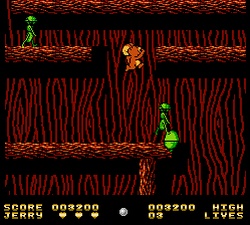
Tom & Jerry on the NES isn’t just a platformer—it’s the purest “cat-and-mouse” chase, where every shelf feels like a mountain, every frying pan like an avalanche, and the footsteps behind you wind their own metronome. You’re Jerry the mouse: tiny, quick, and the entire house is your route. You spring across armchairs, scale stacks of books, skim a slick countertop, and eyeball the distance to the next safe lip. Then—crack—a paw slams down beside you, and Tom & Jerry flips into straight adrenaline. It’s that rare case where a familiar cartoon wakes up in your hands, and you can literally feel the rhythm of the pursuit.
The rhythm and breath of the chase
It’s all about tempo. Tom & Jerry: The Ultimate Game of Cat and Mouse! keeps you in short, precise inputs: jump—beat—throw—step back—jump again. Corridors pinch in, a shelf underfoot is tiny, and the floor below is a hazard course. You snag your moment like a circus acrobat, slip past a nasty contraption, dive into a tight opening, and avoid the hit. It’s that “made it by a hair” feeling that makes you boot it right back up, crack your knuckles, and storm the house again. No filler here: you read movement, parse trajectories, and drop your jump right on the metronome’s downbeat.
The house as a battlefield
Rooms look familiar, but the rules are different. In the kitchen, every surface is a timing test; hot spots make you tuck your tail, and little pests turn the countertop into a freeway full of erratic drivers. In the living room, soft furniture morphs into a springy obstacle course: couches pop you up, armrests wreck your pace, and the rug tugs you back. The basement is darker, echoey—you’re listening to footsteps above—while the attic is beams and dust, where one sloppy move ends with a long drop and a short “oh, come on.” The house isn’t just a backdrop—it breathes, squeezes space, and forces you to carve lines like a dance.
Cat vs. mouse: no-discount duels
Tom isn’t just window dressing. “Cat Tom and mouse Jerry” here means a fair duel. He shows up right when you think you’ve got the groove—and knocks you off-beat. You learn to read his bursts and throws, measure safe jump spacing, and find windows to answer back. In those beats, a Tom and Jerry NES run becomes a string of micro-decisions: disengage or poke, snag the cheese or use cover, push forward or wait it out. Nail it, and a little spark of victory fires through your fingers.
Traps and little wins
The secret’s in the small stuff. Cheese isn’t just score: it breadcrumb-trails the route, hinting at your line through the tricky sections. A mousetrap is both threat and waypoint—perfect to spring off if you catch the beat. You stitch momentum from a few clean jumps, pounce on a safe window, and fling whatever you’ve got at your foe. Jerry’s “weapons” are tiny, but accurate enough to stuff a bully on a ledge and buy a couple seconds of air. Seconds stack into minutes, and minutes add up to a whole stage.
How it plays on your end
The best thing about “Tom and Jerry on the NES” is when you start thinking like a mouse. Not just jumping, but pre-visualizing the bounce, where you’ll plant, when you can afford a glance. The deeper you go, the more rhythm rules: steps get shorter, pauses tighter, and your eyes automatically scout for safe ledges. That focus turns into pure pleasure. Intuition and memory carry you: you remember the traps that burned you last time and slide through with confidence now, because you know the “right way through the kitchen” or how to clear that cursed gap before the closet. It’s the moment when your hands outrun your thoughts—the flow state.
Little tricks and the “how do I…?”
This isn’t about cheat codes—it’s about attention. Every “secret” is a better read on a room’s tempo. Two hazards in a row? Split the move into two short phases—don’t force a big hero leap. Spot a pattern in an enemy? Edge in, wait for the peak of their arc, then zip underneath. And yes, cheese often marks the correct line, but sometimes stepping off the “ideal route” is the safer insurance. That’s how a run comes together: not from dramatic sprints, but from measured spacing over distance. One step saved now is one mistake dodged later.
The real “cat-and-mouse” game
Tom & Jerry: The Ultimate Game of Cat and Mouse! wins by making you feel every inch of the screen. No long explanations—just a fair loop: rush and you’re punished; stay cool and you’re rewarded. When Tom flickers into view, you can almost hear your breath shorten—and still you find the beat, stick that precise jump, and slip the paw. House by house, room by room, you piece together your perfect route, where the chase turns into a tightly tuned dance. That’s why you come back—not for raw difficulty, but for the moment when a well-timed step clicks into a small miracle of a win.